This post is in response to a request to talk about handling taxes when you have your own business.
People from over 104 countries read the Subconcious Tonic blog. I can't answer this in one way to apply to all people. But regardless of where you are, and as I've mentioned before, if you're doing business, do it legitimately. In the United States, that means, get a Tax ID.
A Tax ID allows you, as a service/product provider to sell goods or services legally. You can get a Tax ID from your local state comptroller's office. But you must register a business name in the Assumed Name office first. They are also a great resource to answer any other tax related questions.
TO CHARGE OR NOT TO CHARGE TAXES
Once you have your Tax ID, you are then able to use other vendors, such as printers, tax free! You're allowed to do this because you're going to turn around and sell that item to your client, and by law, you're supposed to charge sales tax.
For example. I am going to order 3000 brochures for a client. I've selected a printer, and once they are complete, I will pay for them. But if I show the printer I have a Tax ID, they will not charge me tax.
The idea is not to pay tax twice.
The sales tax you charge your customer will have to be paid to the state comptroller at the end of each fiscal year. Depending on how much money you make, you may have to pay taxes quarterly.
DO I HAVE TO PAY MORE TAXES DURING INCOME TAX TIME?
Yes. Because the money you are receiving is considered an additional source of income. So you are required, by law, to report any income and pay taxes on them.
WHAT ELSE IS A TAX ID USED FOR?
You're only allowed to use it when you're buying products that you will resell to a customer. I just made 15 hats for a client that had custom embroidery. I could buy those hats tax free from one vendor, and the vendor who did the embroidery could do it tax free as well. Get it?
Please post any questions you may have about your business below. Good luck! -Kelada
Thursday, November 6, 2008
How do I handle my taxes if I have my own business?

Sunday, September 28, 2008
6 Tips for Choosing a Print Vendor

COMMON TYPES of PRINTER REQUESTS FROM FREELANCE DESIGNERS
In most cases, you've probably already talked to your client about what kind of paper quality, etc. they want. But then what do you do once you know?
First you need to determine what it is you're printing, here's a list of a few things you'll probably find yourself needing to print for a client:
- business cards
- fliers / brochures
- post cards
- custom promotional items
RULES YOU NEED TO KNOW
These are my own made up rules from my experience. It's always good to be fair in business, but not everyone is. Here's your turn to show your good intention and start good habits.
1. Always get at least 2 different vendor bids
Getting more than 2 vendor bids is usually best. I often do 3. What's the point? Just to make sure you're getting fair rates, plus it shows your client that you're really looking at his best interest.
This rule applies to all vendors, including promotional item vendors.
2. Determine the need to go to a print house or do it digitally from an online vendor
Online printing is because more and more common. I do most of my small print jobs like business cards and brochures through online print companies. You can always requests samples to see their quality. Most of the online vendors have a guarantee.
There are small franchise printers like MinuteMann Press and Kwik Kopy who are also digital printers. I just find them to be unreliable with extremely low quality assurance practices. Hey, I'm sure some people have had good experiences. I'm not one of them.
The difference between an online printer and print house is simply they're methods of printing.
 ATTRIBUTES OF ONLINE PRINTERS
- Mostly digital, requires less pre-press time
- Limited paper /coating / color options
- Cheap
- Great for small runs (small quantities)
- Works with simple files like pdfs
- Usually out-of-state, so there's a shipping cost
- Tax free if the vendor is out-of-state (at least this is true for Texas)
- Reliability: they usually specialize in these routine orders, so there's less chances for variance
- Online work-order management: you can always re-order, and upload files at a click of a button. It's hassle free, quick and you can manage your orders 24/7.
- Skip the trip to the UPS store: Online printers offer blind mailing. That means, when an order is shipped to your client directly from the printer, you can choose to have your company name as the return address, instead of the printers' address. Which means, you don't have to wait for the printer to send you the finished pieces, and then go to the UPS store and send it yourself.
- Offers standard binding and folding
- If your client is short on money, you may be a hero if you choose a digital print vendor
 ATTRIBUTES OF PRINT HOUSES
- True print veterans. These people are experts with their craft, and do everything by hand. Mixing colors (Pantone, CMYK) to die cuts. They are extremely knowledgeable and have seen every strange print request possible.
- You get a personal account manager to handle all your print jobs, and years later, you'll probably have the same account rep, who will remember you.
- Specialize in custom requests, packaging, die cuts, special papers, inks.
- Often takes longer than digital printing, because of the prepress time.
- Print houses are great for large runs (large quantities, minimum 3000 pieces) Although, they can do smaller jobs, it's just more cost efficient to do larger ones.
- Have loads of paper options
- Can offer special requests for binding, folding, die cuts
- Tend to be more expensive, because it's usually much better quality
It make you feel pretty bad when you choose a company to do your print work, and you can't find your account rep., or they really don't care about your business. It makes you look bad in front of your client if you keep putting things off because of your vendor.
"Account Representatives" are common names for "sales people" at a print production house. When you call a printer (also known as print house, print bureau, print shop, print vendor, printer) you will be assigned with an account rep. That account rep is responsible for listening to your requests and finding the best options to meet your budget constraints and special needs. Good account reps try to meet with their client face-to-face.
Account reps who build relationships with you are often more reliable. If they give you a price that's too high, show them your competitive quote, and they'll often match or go lower to win your business.
4. Know your stuff

It's easy to place an order online to print business cards, but do you know what 4/4 is? How about aqueous? And 14 pt?
Do your research and find out the lingo of the paper and printing business. Working with a professional print house, they see people with no experience in the biz, but if you're claiming to be a designer, you need to know the lingo to speak to your vendors. Plus, it ensures they are doing everything you ask for.
5. Know how to charge your client
Let's say your client wants a bid from you to print their brochures. You tell them, you'll get it to them in a week. That gives you enough time to get 3 vendor bids back. Once you select a vendor, be sure they aren't charging you tax. (Because you are a legitimate business owner, with a tax resellers ID, you shouldn't be paying tax twice.) Meaning, the printer should not charge you tax, because you're going to turn around and charge your client the tax. (Proper way of doing business.)
Find out what your markup will be, 10%, 20%? Decide what the markup will be, and present that to your client. You have to get paid for your leg work in working with the printer. Sometimes, I give the client the option. Do they want me to work with the printer, or are they going to do it themselves? You'll be surprised how many times a client will have a printer already in mind.
6. Prepare the artwork properly
It's almost impossible to do this perfectly every time. Not your fault, each printer has different versions of software, or machines that require different parameters of your artwork.
The best thing to do to avoid working needlessly, is always ask your printer, before you start designing, what their preferred artwork format is. Some like compressed pdf, some like eps.
I tend to be safe and do all of the ways. I usually create my artwork in InDesign CS3 and package the artwork so that it includes all the links and fonts. I also export a high-res pdf. Most print houses will want you to print out a sample on your printer as reference.
The most common mistake printers have from freelancers are:
- Fail to create outlines with the text/font
- Fail to import only eps / tiff images with CYMK color mode (remember RGB is for the screen)
Thursday, August 2, 2007
What do I need to start a business?
You gotta have:
A Good Name Choose a name that expresses your creativity, professionalism and objective of your business. Avoid using the word "Freelance" in your title, you may use it casually if it comes up in conversation. Once you pick a name, come up with several backup names in case someone else has registered that name.
Next, go to the local court house, find the "Assumed Name Office." Once you're there, that person will search the county records to find out if someone has already registered that name. If they haven't, you're in luck, pay them the $12 bucks (or whatever it is now) and you'll get a paper certificate showing the county you registered the name. Congratulations, you have nos received your official DBA (Doing Business As ..." A DBA, also known as a Sole Proprietorship is not the same as Company. These are legal terms for the US Government to determine how you will pay your taxes. With a DBA, you will be paying taxes using your social security number.
Sales Tax Many people don't think of this, but if you want to do business LEGALLY, you must get a sales tax ID. Basically this means, you are charging sales tax to your client, which you then have to pay to the state. (Regardless of their method of payment.) Once you get your DBA, take your drivers license and DBA to your local State Comptrollers Office. They will ask you a bunch of questions about what kind of business are you doing, where you live, etc. They do this because sales tax is different depending on WHERE you will be doing your work. For example, Harris county is 8.25% but outside the city limits, Harris county may be 6.25%. Yes, you will have to learn how to pay your taxes and the laws with running a business. The State Comptroller Office will be glad to explain things to you.
The Right Tools What's the point of being a graphic designer if you don't have the right tools? Unfortunately, when you have your own business, you have to spend the money to keep up with the software versions and equipment. Your clients expect this of you, and are paying for the quality not only in your work but in the tools you use. Be on top of your game, and you will get more business.
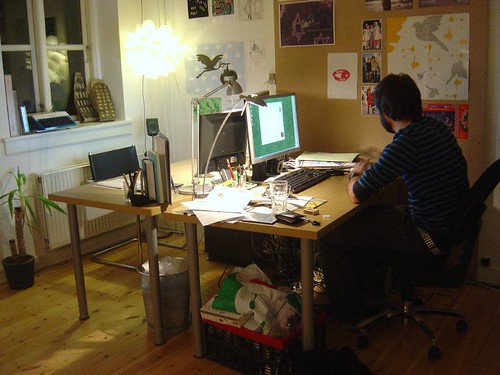
A Place to Work You can work anywhere as a graphic designer. It's probably a good idea for you to get a laptop you can use to travel with. Sometimes the client will expect you to work at their locations for certain projects or design checks. You can setup a dedicated space at home for your office and can get a tax break.
Create a system for organizing your files, invoices, etc. that are PRINTED and can be accessible without your computer. Losing a clients file or work is just not acceptable, and you will pay for mistakes like this. The last thing you want to have is a bad reputation. It's a small world!
Web site With Your Own Domain I have a saying, that if they don't have a Web site, don't do business with them. A Web site is a business' image, if there is no image, there is a feeling of being unprofessional and unreliable.
Why on earth would you NOT have a Web site if you are a graphic designer? They are important for photographers as well. No Web site = suicide for your business. Getting your own domain is cheap, and there are hundreds of trusted companies to host your site. I use doteasy.com. Don't use a free host that uses ads. Choose a short, memorable domain address.
Look and Play the Part When you meet with clients, dress professionally -- even if you are expressing yourself. You are representing your company now. Your clients want to feel confident that their investment in you is a good one. This means, not only dressing professionally but acting professional in all your correspondence and interaction with them. Timeliness and constant follow-up is key. Odly enough, even though technology is part of the DNA of the new design generation, you guys don't check your e-mail often enough. Learning to write professional e-mails is EXTREMELY crucial in getting and retaining your business relationships. ALWAYS read and reread your e-mail before you hit "send."
Sell Yourself Remember, you are in the business of communication; therefore, you must understand, you are selling yourself as a product as well. To succeed as a freelance designer, you will have to market and sell yourself, in what can be uncomfortable until you get used to it. Cold calling, advertising online and in the newspaper, forums and more importantly and reliable -- word of mouth (Networking).
Other things you may experience ...
1) You will get bad clients from time to time. I find these to be small businesses with very low or no budget.
2) You'll have to bust your butt to establish credibility as a business and surpass the competition. You'll find that it's easy to do if you're truly talented and have great networking and negotiation skills. Take a class or seminar to give you a boost in the areas you don't feel too confident in.
3) Be patient. It takes time to get established.
4) Freelance graphic design isn't for everyone. Many people work best in agency situations.
Do any of you have any other advice you'd like to add? Maybe some of your own experiences in starting a business? Let us know, select the comments link below.

Monday, June 25, 2007
How much should you charge for freelance?

Competition - do some research and find out what your competition is charging.
The Client - you'll find that you can charge more if you're doing work for corporations (not creative agencies). Corporations, from my experience, have a harder time finding designers. Not to mention, the person who is hiring you will be passing on your invoice to the billing department and won't think twice to sign your contract. Downside is, the work is very inconsistent and often very small.
If you find yourself freelancing for a design company, chances are, they are hiring you to do work that they don't have time for -- project overflow. At this point, you're third party, which means they will pay you less, and charge the client more to make profit. The upside to this, is that there is a lot of work from agencies that need to be outsourced.
If you're looking for more money without all the hottie tottie brands, work for a non-design company, i.e. oil and gas, law firms, etc.
Your Experience - Your experience provides clout to what you charge. Meaning, if you charge $75 per hour, that means you have been around and have samples to backup your claim. $35 an hour, I think, is a good start for entry-level designers who are freelancing. (Talk to me about your project, and I can help you. Sometimes I will charge different rates for different projects.) So it's not just about how good you are, but people with several years design experience are more efficient, and produce the work faster and with better execution and strategy.
Judge The Book By The Cover - Charge how much you think you can get away with. Small start-up companies don't pay anything, so you can't expect too much pay. If it's a huge, international company, charge em' up baby. Don't be too ridiculous. Be fair so you get return business.
Charge For Research & Prep Time - many designers only charge based on the actual design time, but rarely consider the research, meetings and travel expenses (time) for meeting with clients. Keep a detailed log for each client's project. I usually create a page with 4 columns. 1) Date 2) hours I logged 3)description of the task 4) mileage. If you're outsourcing to a printer, give the client two separate bills. One for your design services and one for printing.
What have been your experiences (challenges and/or advice) on quoting for a project? What are your best practices? Select the "comments" link below to post your response.
Here are some documents you can use to get your business started:
>> Design Brief Sheet
>> Client Job Log
>> Project Calendar
>> Freelance Legal Forms/Contracts/Agreements
>> Sample Creative Strategy
>> Client Art Approval Form
>> Web Site Marketing Price Guide


